OpenAI on Google Cloud: A Practical Guide for SaaS Builders
What the OpenAI and Google Cloud partnership means for SaaS builders, with a practical framework for evaluating model quality, cost, latency, and rollout risk.

OpenAI on Google Cloud gives SaaS builders a new reason to rethink model choice, but not a reason to rewrite a working product overnight. The useful question is not which vendor won the announcement. It is whether another deployment option can improve a specific customer workflow without creating unnecessary cost, operational complexity, or risk.
On October 21, 2026, OpenAI and Google Cloud announced their partnership. This article separates the confirmed rollout from the practical decisions a small engineering team should make next. The evaluation framework below is a proposed approach, not a report of hands-on benchmarks.
What was announced, and what is available?
Google Cloud says GPT-6 Astra, GPT-6.1 Sol, and GPT-6 Luna are rolling out in Model Garden through a private preview for selected enterprise customers. Its announcement describes purchasing through Google Cloud Marketplace, with usage contributing toward eligible existing cloud commitments. It also marks Antigravity and Gemini for business availability, Zero Data Retention options, and Confidential Compute as coming soon. Read the Google Cloud rollout announcement for the precise scope.
OpenAI says general availability is planned in the coming weeks, rather than giving a guaranteed public launch date. It also confirms that Microsoft remains its primary cloud partner. See the OpenAI partnership announcement. These details were checked on October 22, 2026; access and commercial terms should be verified again before implementation.
Start with the workflow, not the model name
A support-summary feature and an autonomous coding assistant should not share the same acceptance criteria. One needs concise, faithful compression. The other may need to navigate tools, recover from mistakes, and avoid harmful changes. Calling both “AI features” hides the work that actually determines success.
Pick one narrow use case before comparing providers. Describe its input, expected output, permitted tools, and unacceptable failures. For a support assistant, that might mean extracting the issue and next action while preserving uncertainty. For document extraction, it might mean returning valid structured fields and flagging missing evidence instead of guessing.
Write the pass criteria before viewing model outputs. This reduces the temptation to reward a fluent answer that quietly fails the task. Treat a confident but unsupported answer as a failure even when it reads beautifully.
Use a five-part model-selection scorecard
1. Quality on representative tasks
Build a small evaluation set from realistic, authorized examples, with personal information removed where possible. Include ordinary cases, ambiguous requests, long inputs, and examples that should trigger abstention or escalation. Keep a separate holdout set so prompt tuning does not become memorization of the test.
Score results against a written rubric. Measure factual correctness, instruction adherence, completeness, and output-format validity separately. A single average can hide a serious weakness on the cases that matter most to customers.
2. End-to-end latency
Measure the time from a user request to a usable result, not just the first generated token. Include retrieval, tool calls, validation, and retries. Set separate targets for interactive experiences and background jobs. A slower response may be acceptable for an overnight report but frustrating inside a live editor.
3. Cost per accepted result
Compare the complete workflow cost rather than headline token prices alone. Count failed attempts, repeat calls, supporting services, and human review. An inexpensive response that needs three retries can be less useful than a more expensive response that passes immediately. Set a budget ceiling and document the assumptions behind your estimate.
4. Operational fit
Ask how the integration will be deployed, observed, and rolled back. Check quotas, supported regions, availability commitments, error handling, and version-change practices for the access you actually receive. Assign ownership for production incidents. A model that performs well in a demonstration still needs an operating plan.
5. Data and permission boundaries
Map what information leaves each component and who can access it. Check the applicable retention and contractual terms rather than treating a cloud logo as an automatic compliance approval. Give tools only the permissions required for their job, and require human approval before consequential actions such as payments or irreversible changes.
Multi-model routing should earn its complexity
Begin with one dependable baseline. Add a second model only when evaluation shows a meaningful improvement for a defined class of tasks. A simple routing rule is easier to inspect than a complicated chain whose behavior nobody can explain.
For example, a proposed document-processing pipeline could use one model for routine extraction and escalate uncertain cases to another model or a human reviewer. This is an architectural example, not a claim that any particular announced model achieves a specific accuracy or price advantage.
Place routing behind an application-level interface. Keep business rules, validation, and authorization outside model-specific prompts where practical. Test each route independently, and log the selected model, configuration version, outcome, and latency without unnecessarily retaining sensitive content.
Do not assume that switching a model identifier makes providers interchangeable. Tool behavior, output conventions, context limits, and error handling need their own compatibility checks. Likewise, a shared invoice does not by itself make an application portable.
A practical pilot before production migration
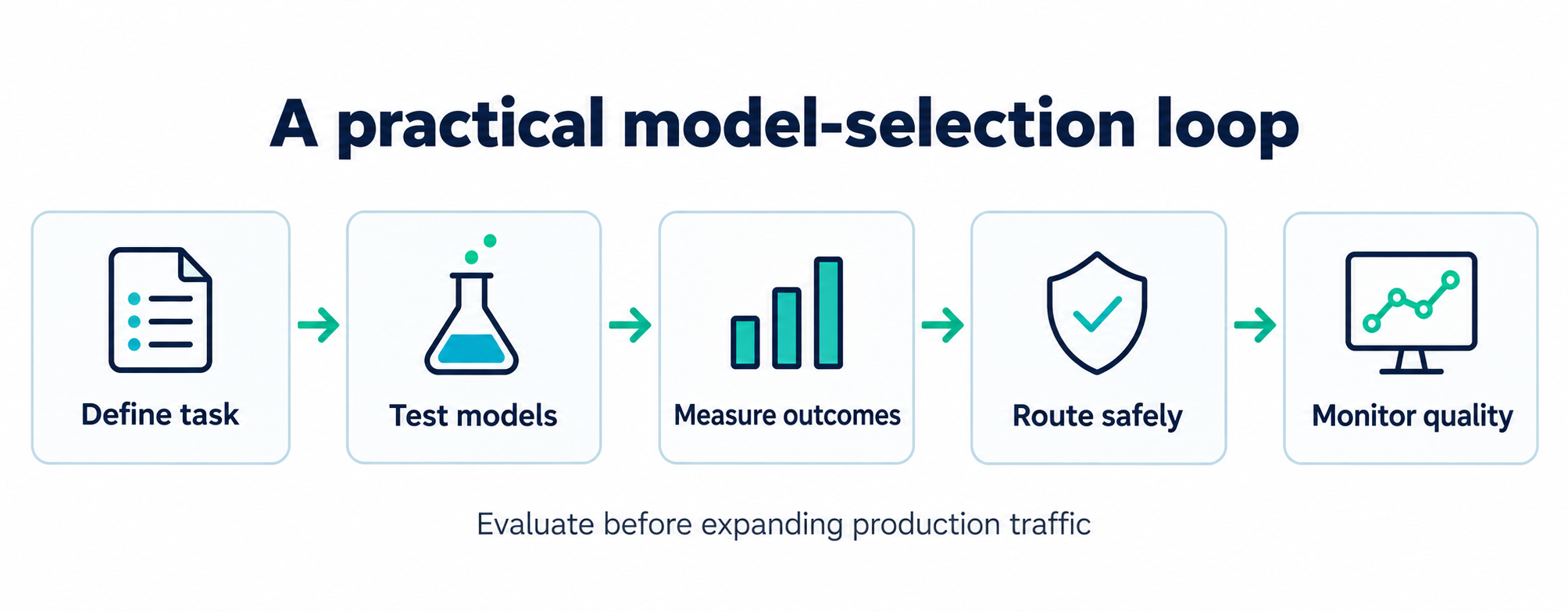
Confirm eligibility. Establish whether your organization can access the preview and which capabilities are actually enabled.
Choose a low-risk workflow. Start with an internal task or a draft-producing feature, not an autonomous action with irreversible consequences.
Record the baseline. Measure the current approach on the same evaluation set and under comparable conditions.
Test the alternative. Review failure cases as carefully as successful examples. Keep prompts and configuration versioned.
Expand deliberately. Introduce limited traffic only after acceptance criteria pass, with clear rollback conditions and monitoring.
Define the stop conditions upfront. A quality regression, unexplained cost increase, or permission-boundary failure should trigger investigation, not another layer of routing added in a hurry. Keep a safe fallback that does not depend on an untested model succeeding.
Frequently asked questions
Can every developer use OpenAI on Google Cloud now?
The announced starting point is a private preview for selected enterprises. Do not plan a release around unrestricted access until eligibility and availability are confirmed for your account.
Should an existing SaaS product migrate immediately?
Not on the announcement alone. A migration should solve a measured problem, such as a quality gap or an operational constraint. If the current setup meets your requirements, an evaluation can be valuable without committing to a switch.
Does multi-model automatically mean cheaper or better?
No. Additional routes introduce testing, monitoring, and maintenance work. The relevant measure is whether the complete system produces better accepted outcomes within your budget and risk limits.
The builder's takeaway
More model choice is useful when it creates a better product decision. Treat this announcement as an opportunity to run a focused evaluation, not as a substitute for one. Start with a real customer problem, measure the full workflow, and let evidence determine whether another model belongs in production.
Editorial note: Availability statements are based on the official announcements linked above. Illustrations are original AI-generated conceptual visuals, not official product diagrams. No model benchmarks or personal testing claims are implied.