Hindi Text-to-Speech for SaaS Onboarding: A 12-Line QA Checklist Before You Ship
Test Hindi and Hinglish SaaS onboarding audio with a 12-line checklist for prices, dates, acronyms and names. Catch meaning errors before shipping.
A Hindi onboarding voice can sound fluent and still tell a customer the wrong price, drop the first zero of a code, or make “do not close this page” sound like permission to leave. For a SaaS product, correctness matters before a voice sounds impressive.
This guide gives Indian product builders a small, repeatable Hindi and Hinglish text-to-speech QA checklist. Start with one real onboarding flow, define what each line must communicate, and review the generated audio before it reaches customers.
Scope: The twelve lines below are proposed test fixtures, not results from an audio benchmark. No voices have been generated or listening-tested for this article, and no provider is ranked. All prices, dates, names and identifiers in the examples are illustrative.
Start with the task, not the voice demo
Choose a narrow flow: creating a workspace, understanding a trial, or completing the first setup step. Decide whether that flow needs Hindi, Hinglish, or separate language versions. A fluent Hindi sentence with an English button label is a different test from a fully translated interface.
Keep the visible interface and spoken instructions aligned. If the button says “Create Workspace,” do not casually translate it into a phrase the user cannot find on screen. Agree on the intended pronunciation of your product name and common acronyms before generating audio.
Write two fields for every line: display text and intended spoken meaning. These need not be identical strings. A price may be displayed as ₹499 while its approved spoken form is “चार सौ निन्यानवे रुपये प्रति माह.” The important part is that the amount, currency and billing period remain unchanged.
The 12-line Hindi and Hinglish QA fixture
Run these examples through the exact model, voice and settings you intend to ship. Replace the examples with approved product-specific equivalents. Do not paste real OTPs, customer records, passwords or API keys into a test script.
Opening and sentence completion
“नमस्ते! अपना नया वर्कस्पेस शुरू करें।”
Check that the greeting and instruction are complete, with no clipped first syllable or missing final word. Record tone separately from correctness.English interface label inside Hindi
“अब Create Workspace पर क्लिक करें।”
The English label must remain recognizable and match the actual button. Listen for an unnatural language switch that makes the action hard to follow.Price and billing period
“यह योजना ₹499 प्रति माह है।”
Approve the spoken amount in advance: four hundred and ninety-nine rupees per month. A wrong amount, omitted currency or monthly/annual mix-up blocks release. This ₹499 figure is only a fictional SaaS-plan example, not a product offer.Indian number grouping
“आपकी सीमा 1,00,000 रिकॉर्ड है।”
The intended quantity is one lakh records. Check both the number and its unit; a natural delivery does not compensate for a lost zero.Explicit date
“आपका ट्रायल 27 अक्टूबर 2026 को समाप्त होगा।”
Check the day, month, year and the meaning of “ends.” Prefer an explicit month name in the script rather than making the model infer an ambiguous numeric date.Time and daypart
“सेशन दोपहर 2 बजकर 30 मिनट पर शुरू होगा।”
The listener should understand 2:30 in the afternoon, not the morning. If the product serves multiple time zones, include the relevant zone in the approved production wording.Identifier with a leading zero
“डेमो कोड 0 4 7 2 है।”
This is a fictional identifier, not the number four hundred and seventy-two. Verify every digit in order, including the leading zero. Spaces are a proposed input choice, not a guarantee of correct synthesis.Acronym and technical label
“अपनी API key यहाँ पेस्ट करें।”
Agree whether API should be spoken as individual letters, then verify it. The instruction must refer to the interface field without speaking any real secret.Payment acronym
“UPI से भुगतान करने का विकल्प चुनें।”
Check that UPI is recognizable and that the sentence asks the user to choose a payment option. It must not imply that a payment has already succeeded.Project or product name
“नया प्रोजेक्ट ‘उड़ान’ खोलें।”
Use an approved pronunciation reference for the name. Do not assume a voice will pronounce a brand correctly because ordinary Hindi words sound good.Spoken help address
“help dot example dot com पर सहायता मिलेगी।”
This reserved example-domain wording is illustrative. Decide how your actual help address should be spoken, and keep a visible, clickable alternative rather than making users reconstruct a URL from audio.Negation and action sequence
“सेव होने तक पेज बंद न करें। फिर आगे बढ़ें।”
The negative instruction must remain intact: do not close the page until saving finishes. Listen for the pause between the warning and the next action, and check the final playback does not cut either sentence.
Use a release gate, not a vague “sounds good” score
Have a fluent reviewer listen to every output against the approved meaning. For a Hinglish flow, choose someone comfortable with both the language mix and the product vocabulary. Ask them to review the audio itself, not just read the script while assuming the generated speech matches it.
Keep two separate decisions:
Meaning and task correctness: wrong amounts, dates, digits, units, names that become unrecognizable, missing negation, or changed actions require rework.
Delivery quality: pronunciation, emphasis, speaking rate and pauses need explicit notes. A stylistic preference should not hide a critical error, and a warm voice should not earn a pass for an incorrect instruction.
A useful review record contains the line ID, exact input, intended meaning, output filename, critical error yes/no, pronunciation note, reviewer and accepted/rework status. Add the generation date, provider, model identifier, voice identifier, settings and pronunciation-dictionary version. Record a model version when the provider exposes it; do not invent one when it does not.
The release gate is simple: no known meaning-changing errors in the shipped flow, and an explicit human sign-off on the final audio. Passing twelve examples is not proof that every future sentence will work. Expand the fixture whenever a real production failure reveals a new edge case.
Fix the input before adding pronunciation markup
First remove avoidable ambiguity. Spell out a month, identify a unit, distinguish a code from a quantity, and use the actual interface label. Keep the approved display text separate from any synthesis-specific normalized input so a pronunciation workaround does not silently change your product copy.
Next, use supported provider controls only when the chosen model, voice and language allow them. ElevenLabs documents model-dependent pronunciation and pause behavior; its guidance is a reason to test the selected configuration, not to assume one markup recipe works everywhere. See the ElevenLabs TTS best-practices reference.
Google Cloud documents a supported subset of SSML for controls such as pauses and how certain text should be interpreted. Microsoft documents pronunciation, substitution and say-as controls with language and phonetic considerations. Check the current Google Cloud SSML reference or Microsoft pronunciation reference for your implementation. Do not copy markup between services without verifying support.
Change one layer at a time and regenerate the affected line. If a dictionary or shared voice setting changes, rerun every line that could be affected. Save the accepted output rather than assuming a later regeneration will sound identical.
Check the real onboarding player before release
Audio that passes in a generation console can still fail in the product. Review the complete flow on the mobile and desktop experiences you support:
Can the user start, pause, replay or skip the audio without losing their place?
Does playback start and end cleanly, without clipping words at a screen transition?
Do adjacent clips flow naturally, without overlapping speech or a pause that suggests the task has finished?
Is the instruction still useful with audio off, through visible text and clear interface labels?
Does the audio match the current price, trial date, button label and product behavior?
Do not rely on a text-only check to approve an audio release. The last review must cover the exact files and player behavior customers will encounter.
A small workflow you can repeat
Use this sequence: approve the script and intended meaning; normalize the synthesis input; generate with a recorded configuration; review each output; then test the assembled flow in the product. Keep accepted files and review notes with the release.
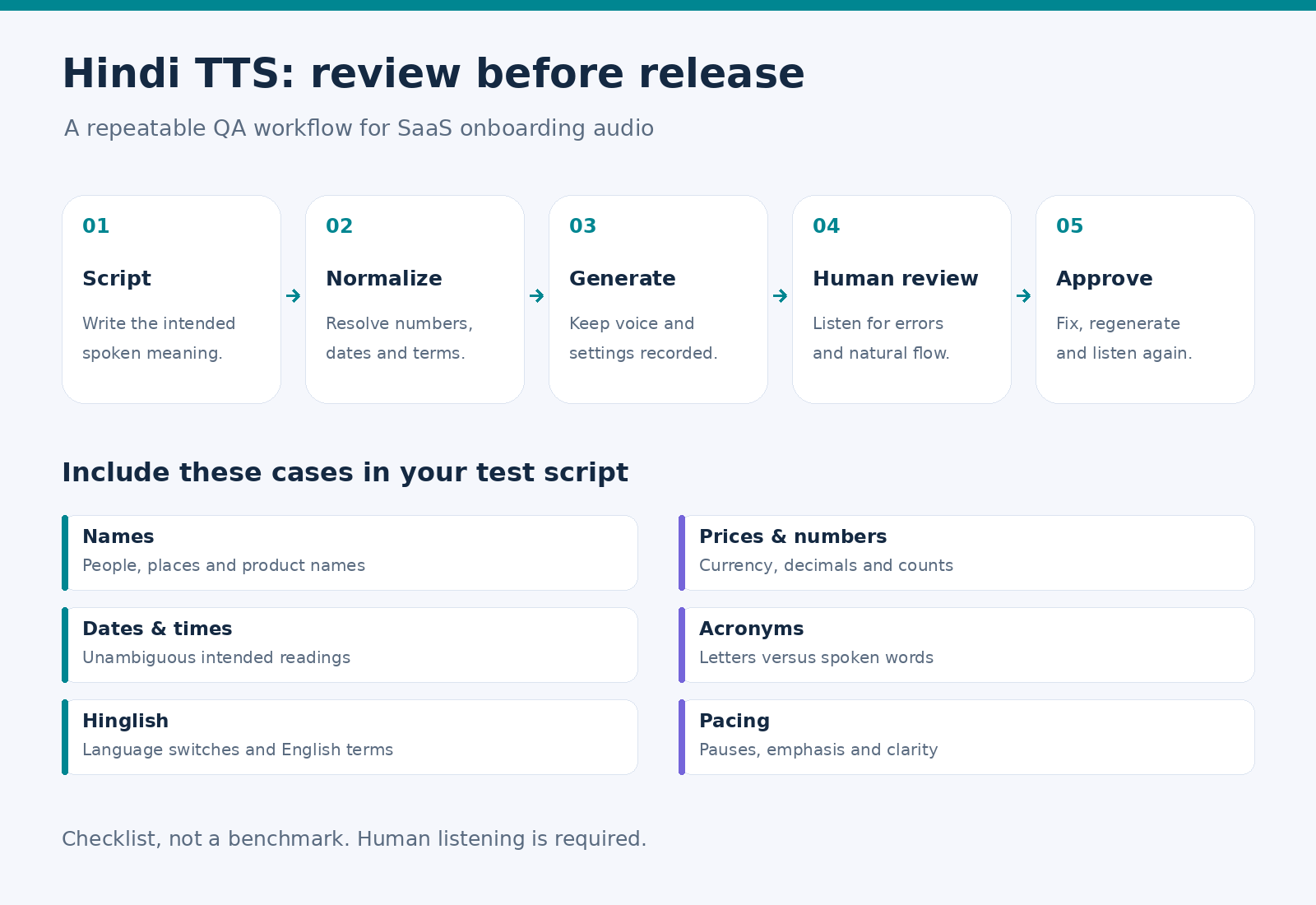
A repeatable Hindi and Hinglish audio QA workflow: approve, normalize, generate, review and check in the product.
Rerun the relevant checks after changing the script, model, voice, dictionary or playback logic. For dynamic sentences, add representative combinations and edge cases rather than treating a single static fixture as complete coverage.
Before you ship: pick one onboarding flow, adapt these twelve lines, assign a fluent reviewer and block release on any meaning-changing error. The goal is not to find a universally “best” Hindi voice. It is to make your own product's instructions dependable.
Technical references checked on 27 October 2026. This is a proposed QA workflow, not a claim of completed model testing, measured conversion improvement or guaranteed pronunciation accuracy.