AI SEO Audit for Indian SaaS: Measure Visibility Before Buying Another Tool
A measurement-first audit for Indian SaaS founders, with a practical worksheet separating AI search impressions, sampled citations, website visits and business outcomes.
An AI-search dashboard can tell a SaaS founder that their brand is becoming more visible. It is much harder to tell whether that visibility reaches the right Indian audience, brings people to the website, or produces useful enquiries.
Before paying for another tool, build a small evidence-based audit. The goal is to find the next useful action, not to produce an impressive score. This guide offers a proposed workflow for an Indian SaaS website. It is not a report of tests performed on a client or a claim that any particular product has achieved higher rankings.
Start with four separate questions
Visibility: Did a search experience show a link to your website?
Citation accuracy: Did a sampled AI answer describe your product correctly and link to a suitable source?
Visits: Did someone arrive on your website through a measurable source?
Outcomes: Did that visit lead to a trial, qualified enquiry or purchase?
Keep these as separate columns. A product mention without a link, a displayed link without a visit, and a visit without a signup answer different business questions. None should be silently converted into another metric.
1. Define a small, India-focused audit
Choose one product and five important pages: the product overview, pricing, a relevant use case, an integration guide and a support or FAQ page. If your site has fewer pages, use the ones you actually have. Do not create filler pages just to complete the list.
Write a one-sentence audience definition, such as “small Indian agencies evaluating a client-reporting tool.” This is an illustrative example, not a description of a tested product. Record which languages your customers use, whether prices are displayed in INR, and which payment, onboarding or support details genuinely matter to their decision.
Select a reporting period that gives your site enough activity to inspect. Four weeks can be a practical starting window, but it is not a promise that a new site will have meaningful data within that time. Save the dates and filters so the next review can use the same scope.
2. Establish the Google AI visibility baseline
Google's Generative AI performance report for Search reports impressions from AI Overviews and AI Mode. It supports page, country, device and date analysis. Use the country controls to isolate India and record the filters with your export. Dates use Pacific Time, not IST; the newest figures can be preliminary.
The report is about impressions, not a dedicated click or conversion total. Google says an absent report usually means insufficient impressions; exclusion from Search generative AI features can also affect eligibility. Search Labs experiments are excluded. Check these explanations before interpreting a missing report as zero visibility.
Do not calculate “AI CTR” by dividing all Google organic clicks by AI impressions. Those populations do not match. Instead, keep AI impressions and your broader organic-search results side by side, clearly labelled. A change in both is a useful observation, not proof that one caused the other.
Record unavailable values explicitly. “Not available in this report” is more useful than a confident-looking zero that nobody can explain.
3. Check the pages before chasing mentions
Google's current AI-search optimization guidance keeps foundational SEO and useful, original content central. Pages must meet Search eligibility requirements, and the site must be included in Search generative AI features. There is no special schema markup that guarantees inclusion, and eligible content is not guaranteed to be indexed or shown.
Use that as a starting point for a practical page review:
Product overview: Can a new reader tell who the product serves, what it does, and what it does not do?
Pricing: Are the currency, billing period, limits and conditions visible and consistent?
Use case: Does the page explain a real workflow rather than a generic list of benefits?
Integration guide: Are the prerequisites, supported steps and failure conditions clear?
FAQ: Do the answers match the current product and link to the relevant detail?
Mark each issue with its page URL, evidence and owner. For example, “pricing page says monthly but checkout says annual” is an actionable problem. “Needs more AI optimization” is not specific enough to assign or verify.
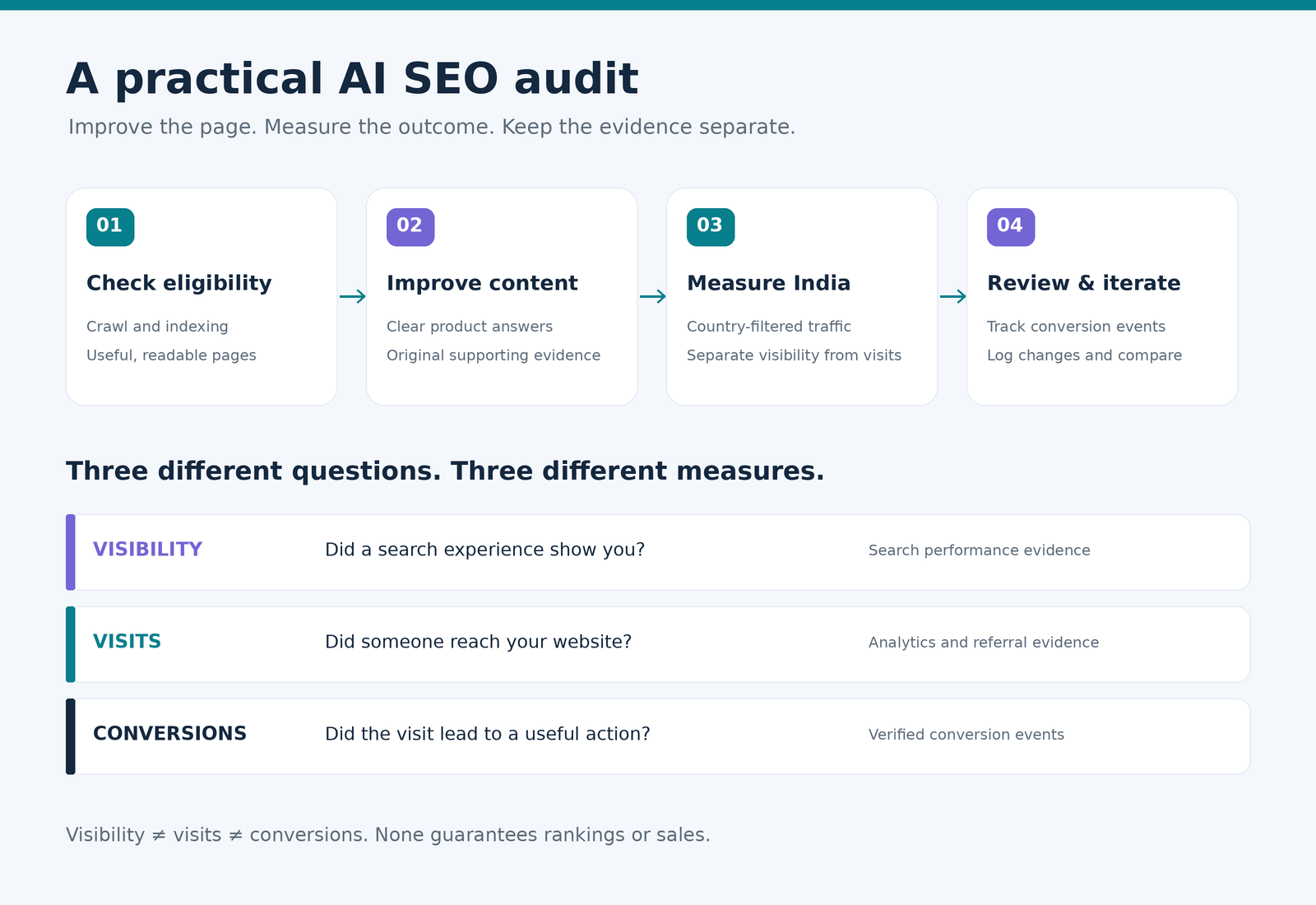
A proposed audit workflow. Search visibility, website visits and conversion events require different evidence.
4. Create a repeatable AI-answer sample
A manual prompt panel can help identify inaccurate descriptions or missing documentation. It cannot measure the entire market. Pick a small set of realistic questions based on actual customer needs, then keep the wording fixed for comparisons.
Useful prompt categories include a task, a constraint, an integration requirement and a product-specific question. An illustrative question could be “What should an Indian agency check before choosing a client-reporting tool?” Avoid asking every engine only whether your own brand is good. That would bias the sample toward mentions.
Include Hindi or Hinglish questions only when they reflect your audience. Record the engine, model label if shown, date, exact prompt, signed-in context where relevant, and location settings you can actually verify. Do not label a response “India-localized” merely because you typed the word India.
For each response, record whether the product was mentioned, whether it was linked, which URL was cited, and whether the description was accurate. Preserve a short evidence note. If you repeat a question, retain the differing results rather than selecting only the favourable one.
Report the result as a dated sample. A handful of answers is not a universal AI ranking, search volume estimate or traffic forecast.
5. Measure visits and useful actions separately
In GA4's Traffic acquisition report, inspect session source/medium, sessions and relevant key events. Use an India country filter or comparison where appropriate. Verify that the intended signup, lead or purchase event is collected correctly before interpreting its totals.
Maintain a list of referral sources you actually observe rather than assuming every AI service always sends a recognizable referrer. Keep unattributed traffic separate. A missing AI referrer does not establish that AI played no role in a customer's journey, and a referral visit does not establish that the visitor became a customer.
Compare matching periods and document the analytics property's time zone. If it differs from Search Console's reporting zone, avoid treating daily totals as perfectly aligned. For business decisions, inspect the quality of the resulting enquiries as well as their count.
6. Use a worksheet that leads to a decision
Create one row per observation using these fields:
Scope: product, audience, page and date range.
Evidence source: Search Console, a dated answer sample, analytics or a verified business record.
Observation: the exact metric or factual issue, with filters and units.
Limitation: missing data, small sample, uncertain attribution or incompatible periods.
Next action: one concrete improvement with an owner.
Review: when and how the same observation will be checked again.
For example, an AI answer that describes an integration incorrectly should trigger a review of the source page and product documentation. It should not trigger an invented traffic-loss estimate. If visibility grows but qualified enquiries do not, investigate the landing page and audience fit before assuming that you need a larger tracking subscription.
When is an AI SEO tool worth considering?
Consider a tool when your manual process becomes difficult to repeat across the engines, pages and questions that matter to your business. Ask the vendor to explain its sampling method, geographic settings, refresh cadence, citation evidence and export options. Find out what is measured directly and what is estimated.
A useful dashboard should let you trace a conclusion back to evidence. An unexplained score, guaranteed placement or a promise of privileged access to ranking systems should not replace that review.
Start with the audit, fix the clearest gaps, and repeat the measurement consistently. If you are building related customer-facing experiences, the Hindi-English website chatbot pilot checklist covers a separate question: how to test source-backed answers and human handoff on your own website.
Technical sources reviewed on 26 October 2026. Reporting features can change. The workflow and examples above are proposed audit methods, not personal testing results or ranking guarantees.